

Lucknow Chikankari Stitches- The Art of Stitching
Lucknow Chikankari Stitches
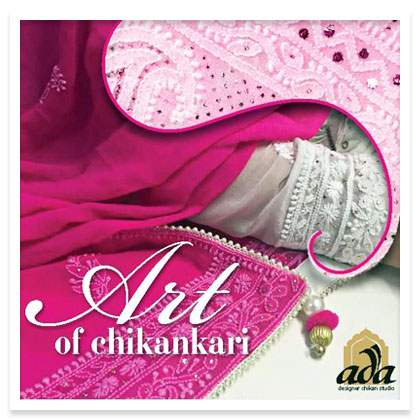
Lucknowi Chikankari is one of its kind hand embroidery, a variety of stitching styles are involved in chikan embroidery. It takes many years for an artisan to master the techniques of chikankari, chikan embroidery requires discipline and precision of detail in its formation. As a result, this art cannot be replicated anywhere. There are 32 stitches of chikankari, which are broadly classified into Raised stitch, Embossed and Flat stitch, and Open Trellis.
Let’s take a look at some of the famous stitches that are practiced in Chikan Embroidery of Lucknow:
Flat Stitches: these stitches merge with the fabric and give an impression that embroidery is itself the texture of the fabric.
-
Keel Kangan: To adorn the petals and floral motifs Keel Kangan stitches are used.

-
Bakhiya: In this stitch, the filling is done on the wrong side while the design is bounded by a running stitch on the right side of the fabric to give a neat look.

- Ulti Bakhiya: Ulti bakhiya is a crisscrossing of thread work on fabric, reverse of shadow work. It gives the look as if the embroidery is itself the texture of the garment.

-
Pechni: Here the Tepchi is covered by entwining the thread over it in a regular manner to provide the effect of something like a lever spring and is always done on the right side on the cloth.

- Tepchi: Tepchi is long running or darning stitch worked with six strands on the right side of the fabric taken over four threads and picking up one. Thus, by this, a line is formed.

- Chana Patti: Short-drawn stitches are made to give a leafy look.
- Badla: Is a stem stitch that is wrapped horizontally with small stitches. It is usually done to make veins of a flower.
- Rahet: An offshoot of the Bakhiya stitch, it is rarely used in its simplest form. Popularly known as “Dohra Bakhiya”, it forms a solid line of the back stitch on the right side of the fabric. Mostly used to create outline stitches.
- Khatau: Just like Rahet, Khatau is also an offshoot of Bakhiya. The most noticeable difference is that it is finer and is a form of appliqué. The design is mostly prepared on a calico which is a plain woven unbleached textile and often not fully processes cotton.
Embossed/ Raised Stitches: As the name suggests it means to carve with a raised effect on the fabric. It provides a grainy appearance to the fabric.
- Ghas Patti: The grass leaves formed by a V-shaped line of stitches worked in a graduated series on the right side of the fabric. It is occasionally done in parallel rows to fill petals and leaves in a motif.

- Phanda: Phanda refers to knots that are in the shape of Millets. Phanda is considered to be a more intricate version. Here, there are knots created. However, these knots are much smaller and far more delicate. It’s mostly used in making the centre of the flowers in simple Chikankari design motifs.

- Murri: It is the diagonal satin stitches worked several times with a knot on a basic tepchi stitch to form a grain shape.

- Dhum Patti: It is a leaf pattern made of cross-stitch.
Open Trellis: stitch is one where the thread is never drawn through the fabric, they are made by teasing the warps and weft yarns apart by needle and holding them in position by small stitches to give it a net effect. This process creates jaalis and regular holes in the fabric.
- Jaali: Jaali stitch is one where the thread is never drawn through the fabric, ensuring that the back portion of the garment looks as impeccable as the front.

- Hool: It is a fine detached eyelet stitch. Here in, a hole is punched in the fabric and the threads are teased apart. It is then held by small straight stitches all around and worked with one thread on the right side of the fabric. Can be worked with six threads and often forms the centre of a flower.

The other stitches which are used in chikan embroidery are:
- Bijli
- Makra
- Kauri
- Hathkadi
- Banjkali
- Sazi
- Karan
- Madrasi
- Taj Mahal
- Janjeera
- Dhania Patti
- Rozan Mehraki
Daraz Stitch:
Daraz is basically a steam stitch drawn with two sides of overlapping fabric cut into various shapes, which were then hand-sewn to give a seam design. 'Machhli', 'Singhara', and 'Sitara' are the famous Daraz stitches used in today's time. 
Related Posts

Lucknowi Chikankari Kurta: 5 Timeless Reasons Every Woman Deserves One

Accessorize Chikankari Outfits the Right Way: Proven Tips for a Modern Look

7 Minimalist Chikankari Outfits That Look Effortlessly Elegant

Chikankari Co-ord Sets: The Biggest Ethnic Fashion Trend of 2026

8 Elegant Chikankari Dresses for Daytime Weddings

White vs Pastel Chikankari: Which Is Trending in 2026?

The Ultimate Summer Ethnic Wardrobe for Women


